

When can conventional surgery be avoided for a lumbar herniated disc?

Endoscopic spine surgery and disc laser treatment offer less invasive alternatives when sciatic pain persists despite conservative treatment.
Being diagnosed with a lumbar herniated disc usually raises an immediate concern: “Will I need an operation?”. In most cases, the answer is not necessarily. Many herniated discs improve with appropriate conservative treatment and the passage of time, especially when there is no significant neurological involvement.
However, it is also important to know when to stop waiting. If sciatic pain continues to limit daily life after approximately two months of properly carried-out conservative treatment —including medication, physiotherapy and injections when indicated— it may be advisable to consider a treatment aimed at the herniation that is compressing the nerve.
The good news is that treating a herniated disc does not always mean resorting to conventional surgery or open surgery. In selected patients, there are minimally invasive techniques such as endoscopic spine surgery and, in certain cases, disc laser treatment.
What is a lumbar herniated disc?
Between the lumbar vertebrae there are discs that act as shock absorbers. When the outer part of the disc weakens or tears, the inner material can shift and come into contact with a nerve root. This compression can cause low back pain, but also sciatic pain: discomfort that radiates from the lower back or buttock down the leg, sometimes accompanied by tingling, numbness or loss of strength.
Not all herniations seen on an MRI scan cause symptoms. That is why images must be interpreted together with the neurological examination and the medical history. The goal is not to treat an MRI, but to solve the problem that is actually affecting the patient.
When can surgery be avoided?
In the absence of warning signs, conservative treatment is usually started. This may include:
- Analgesic and anti-inflammatory medication, always prescribed and supervised by a professional.
- Physiotherapy and therapeutic exercise adapted to the stage of the condition.
- Postural education and temporary modification of activities that trigger pain.
- Selective injections in specific patients, when radicular pain hinders recovery or prevents rehabilitation.
This approach may be enough when pain decreases progressively and there is no loss of strength. However, continuing indefinitely with treatments that are not working is not always the best strategy. If intense, disabling or recurrent sciatica persists after about eight weeks, a new assessment by a spine specialist is recommended.
When conservative treatment fails: addressing the cause
Persistent sciatic pain should not be normalised. When the herniation continues to compress a nerve root and the patient does not improve after a complete course of conservative treatment, nerve decompression may be considered.
This does not mean that conventional surgery is the only option. The decision depends on factors such as the location and size of the herniation, the degree of compression, the course of symptoms, the neurological examination and the characteristics of each patient.
In this context, the goal is to treat the herniation as precisely and as non-aggressively as possible, preserving the healthy structures of the spine and enabling a faster recovery.
Endoscopic spine surgery: a minimally invasive alternative
Endoscopic spine surgery allows access to the affected area through a very small incision, using a high-precision camera and specific instruments. The surgeon can identify the nerve root and remove the disc fragment compressing it, without the need for extensive exposure of the muscles and posterior structures of the spine.
Its potential advantages include:
- Less damage to muscle tissue.
- Small incisions.
- Less postoperative pain in many patients.
- Faster mobilisation and hospital discharge in selected cases.
- A progressive return to usual activities in less time.
Endoscopy is not a suitable technique for every herniation, nor does it replace an individualised assessment. In certain cases, conventional minimally invasive surgery or another procedure may offer better guarantees. The choice should be based on the diagnosis, not just on the name of the technique.
Disc laser treatment: when can it be useful?
Disc laser treatment is a percutaneous procedure that uses laser energy to act on the inside of the disc. Its purpose may be to reduce intradiscal pressure and lessen the irritation related to certain disc lesions.
It may be considered in selected cases, especially when there is a contained disc lesion and the pain has a discogenic component. However, not all herniations respond in the same way. When there is an extruded disc fragment directly compressing the nerve, laser may not be the most appropriate option and a decompression technique, such as endoscopy, may need to be considered.
For this reason, before recommending laser treatment it is essential to review the images, confirm that the symptoms match the affected level and rule out compression that requires the herniated material to be physically removed.
When should you not wait?
Although many patients can initially be treated without surgery, some situations require priority medical assessment. It is important to seek care promptly if any of the following appear:
- Loss of strength in the leg or difficulty walking on tiptoes or heels.
- Progressive neurological deterioration.
- New problems controlling urine or stools.
- Loss of sensation in the genital or perineal area.
- Severe pain associated with fever, major trauma or other general symptoms.
These signs may indicate significant nerve involvement and should not be managed only with painkillers or by waiting for the problem to resolve on its own.
The decision must be personalised
The right question is not just “Do I have a herniation?”, but “Does this herniation explain my symptoms, and which treatment offers the best balance between benefit and risk?”. To answer it, the specialist must combine the clinical examination, the MRI and the response to conservative treatment. If you would like your case assessed, you can make an appointment.
Frequently asked questions about avoiding lumbar herniated disc surgery
Can a lumbar herniated disc be cured without surgery?
Yes, a lumbar herniated disc can be cured without surgery in many cases. Most improve with conservative treatment (medication, physiotherapy, therapeutic exercise and injections when indicated), especially when there is no loss of strength or other signs of significant neurological involvement.
How long should you wait before having surgery for a lumbar herniated disc?
Before having surgery for a lumbar herniated disc, around eight weeks of properly carried-out conservative treatment is usually recommended. If intense, disabling or recurrent sciatica persists after that time, a new assessment by a spine specialist is advisable, unless warning signs appear that require earlier action.
What are the advantages of endoscopic spine surgery over conventional surgery?
The advantages of endoscopic spine surgery over conventional surgery are less damage to the muscles, very small incisions, less postoperative pain in many patients and faster mobilisation, hospital discharge and return to activity in selected cases.
Is disc laser treatment suitable for any herniated disc?
No, disc laser treatment is not suitable for every herniated disc. It may be useful for contained disc lesions with discogenic pain, but when an extruded fragment directly compresses the nerve, a decompression technique such as endoscopy is usually needed.
When should you see a doctor urgently for a herniated disc?
You should see a doctor urgently for a herniated disc if you notice loss of strength in the leg, progressive neurological deterioration, new problems controlling urine or stools, loss of sensation in the genital or perineal area, or severe pain with fever or after major trauma.
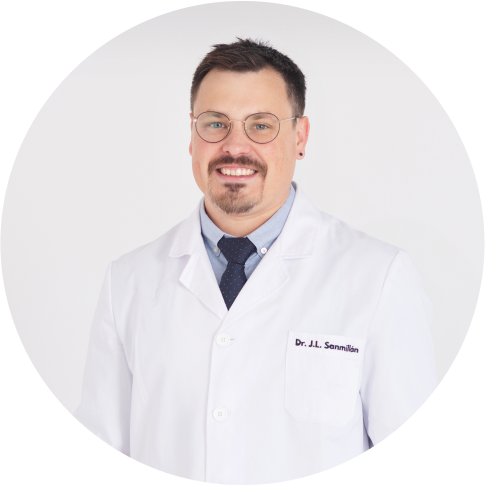
Dr Sanmillán
Collegiate number 080845986
Highly specialized neurosurgeon, with more than 10 years of experience in minimally invasive techniques and extensive experience in endoscopic surgery and endoscopic spine procedures.